
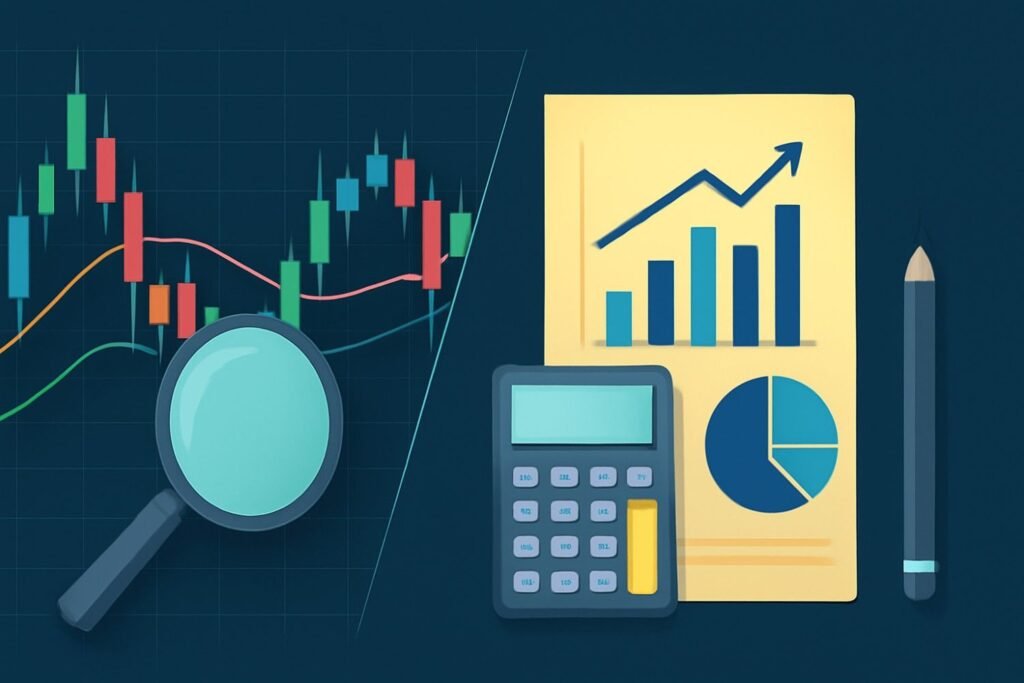
In Forex trading, the tools you use to analyze the market play a significant role in determining your success. Two of the most widely used methods for market analysis are technical analysis and fundamental analysis. Each approach has its own set of tools, strategies, and strengths. While they both aim to predict future price movements, they do so in fundamentally different ways.
In this article, we’ll break down the differences between technical analysis tools and fundamental tools, helping you understand how each method works and when to use them in your trading strategy.
What is Technical Analysis?
Technical analysis involves studying price charts, patterns, and indicators to predict future price movements. It’s based on the assumption that historical price data can help identify trends and potential market behavior. Technical analysts focus on price action, volume, and chart patterns to make trading decisions, disregarding external factors like economic reports or geopolitical events.
Key Features of Technical Analysis:
-
Price Action Focus: Technical analysis is primarily concerned with past price movements and the belief that history tends to repeat itself.
-
Market Sentiment: Technical analysis reflects the collective market sentiment and psychology of traders.
-
Short-Term to Medium-Term: It’s typically used for short-term to medium-term trading, such as day trading, scalping, or swing trading.
Popular Technical Analysis Tools:
-
Charts: Price charts (line, bar, and candlestick charts) are the foundation of technical analysis, providing a visual representation of past price movements.
-
Indicators: Popular indicators include:
-
Moving Averages (MA): Used to identify trends.
-
RSI (Relative Strength Index): Measures overbought or oversold conditions.
-
MACD (Moving Average Convergence Divergence): Tracks momentum and trend direction.
-
Bollinger Bands: Measures market volatility and overbought/oversold conditions.
-
-
Chart Patterns: Patterns such as head and shoulders, triangles, and double tops/bottoms are used to predict potential price reversals or breakouts.
-
Volume Indicators: These show the strength of price moves by analyzing trading volume.
What is Fundamental Analysis?
Fundamental analysis involves evaluating the economic, financial, and political factors that influence currency values. Traders who use fundamental analysis examine economic indicators, central bank policies, and global events to understand the underlying value of a currency and predict its future price movements.
Key Features of Fundamental Analysis:
-
Economic and Political Focus: Fundamental analysis looks at macroeconomic factors such as GDP growth, inflation, unemployment rates, and interest rates, as well as geopolitical events.
-
Long-Term View: This analysis method is typically used for long-term trades, such as position trading, where the trader expects the value of a currency to change gradually over time.
-
Market Context: It focuses on understanding the broader context that drives currency values, including news events, central bank policies, and global trade.
Popular Fundamental Analysis Tools:
-
Economic Calendars: Track major economic events and data releases that can influence currency prices, such as GDP reports, employment figures, and inflation rates.
-
Interest Rates: Central bank interest rate decisions are crucial in Forex markets. Higher interest rates generally lead to a stronger currency.
-
Economic Indicators: Key reports include:
-
Non-Farm Payrolls (NFP): A significant U.S. jobs report.
-
Consumer Price Index (CPI): Measures inflation and price changes.
-
Gross Domestic Product (GDP): Indicates the overall economic health of a country.
-
-
Central Bank Statements: The policies and outlooks provided by central banks (e.g., the Federal Reserve, European Central Bank) directly influence currency strength.
-
Geopolitical Events: Political instability, elections, and trade negotiations can have a major impact on currency values.
Key Differences Between Technical and Fundamental Analysis Tools
Now that we understand the basics of both analysis methods, let’s explore the key differences between technical analysis tools and fundamental tools:
| Aspect | Technical Analysis Tools | Fundamental Analysis Tools |
|---|---|---|
| Focus | Price action, charts, and patterns. | Economic indicators, news, and macroeconomic data. |
| Time Horizon | Short-term to medium-term (minutes, hours, days). | Long-term (weeks, months, years). |
| Market Data Used | Past price movements, volume, and chart patterns. | Economic reports, central bank policies, and geopolitical events. |
| Tools Used | Moving averages, RSI, MACD, Bollinger Bands, chart patterns. | Economic calendars, interest rates, GDP, CPI, NFP, central bank statements. |
| Type of Analysis | Technical patterns, price trends, market sentiment. | Economic health, monetary policy, inflation, and interest rate decisions. |
| Best For | Day trading, scalping, swing trading. | Position trading, long-term trades based on economic outlook. |
When to Use Technical Analysis Tools
Technical analysis tools are ideal for traders who are focused on short-term or medium-term trades. These traders often make decisions based on immediate market conditions, aiming to profit from small price movements. Here’s when technical analysis is most beneficial:
-
Day Trading: Technical analysis tools are critical for day traders, who need to make quick decisions and capitalize on small price fluctuations throughout the day.
-
Scalping: Scalpers benefit from using technical indicators to execute rapid trades in seconds or minutes, often relying on tools like RSI, MACD, and moving averages to spot potential entry and exit points.
-
Swing Trading: Swing traders use technical analysis to identify short-to-medium term trends, typically holding trades for a few days to a few weeks.
When to Use Fundamental Analysis Tools
Fundamental analysis tools are essential for traders who take a longer-term approach to trading. These traders evaluate economic conditions, political events, and global trends to make decisions about currency values over time. Here’s when fundamental analysis is most beneficial:
-
Position Trading: Position traders use fundamental analysis to capture long-term market moves, holding positions for weeks, months, or even years.
-
Market Sentiment: Traders who focus on market sentiment often use fundamental analysis to understand how global events impact currency markets, adjusting their positions accordingly.
-
Impact of News and Events: Forex traders who focus on major economic reports (e.g., NFP, CPI) or central bank decisions (e.g., interest rate hikes) can take advantage of the volatility these events create.
Combining Technical and Fundamental Analysis
Many successful Forex traders use a combination of technical and fundamental analysis to create a comprehensive trading strategy. Here’s how you can combine both:
-
Use Fundamental Analysis for Big Picture Direction: Start by analyzing the economic outlook, interest rate policies, and key global events. This helps you determine the broader trend and the overall direction of a currency pair.
-
Use Technical Analysis for Timing Entries and Exits: Once you have a general idea of the trend based on fundamental analysis, use technical tools (such as RSI, moving averages, and support/resistance levels) to fine-tune your entry and exit points.
For example, if the U.S. economy shows strong growth, supported by positive economic indicators like GDP growth and low unemployment, you may decide to buy USD. To find the right entry point, you could use technical analysis to identify key support levels and chart patterns for a precise entry.
Conclusion
The choice between technical analysis tools and fundamental analysis tools depends largely on your trading style, time horizon, and goals. Technical analysis is best suited for traders focused on short-term trades, while fundamental analysis provides insights for long-term traders interested in macroeconomic factors and currency valuation.
By understanding the differences and when to use each set of tools, you can create a more robust and informed trading strategy. Many successful traders choose to combine both approaches to get a more comprehensive view of the market, increasing their chances of success in Forex trading.