
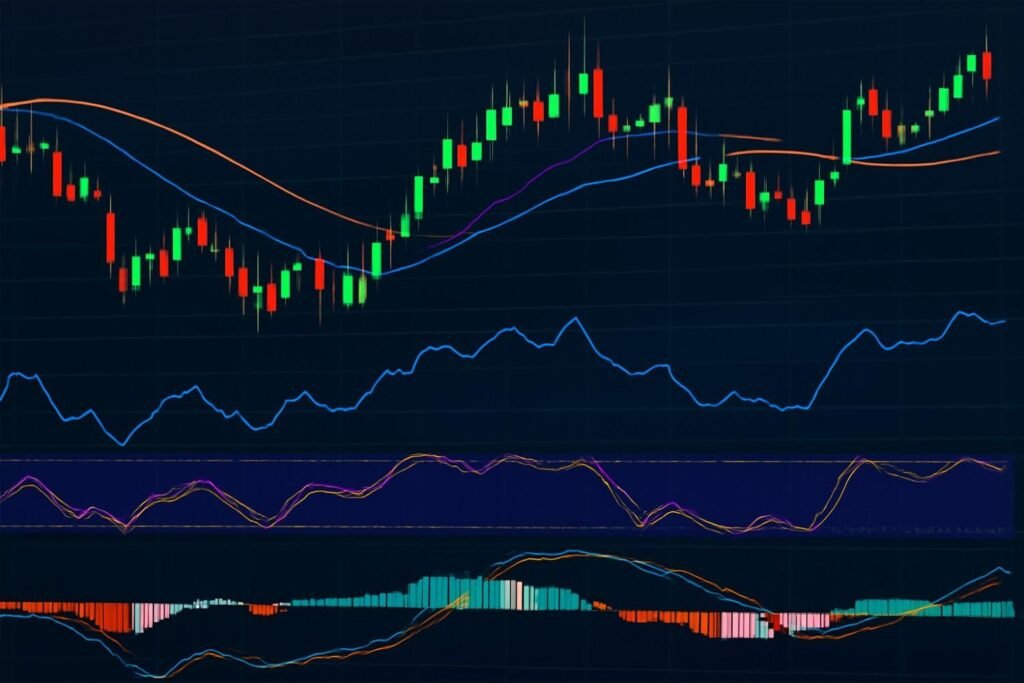
In Forex trading, indicators are an essential tool for making informed decisions. Indicators help traders analyze price movements, identify trends, and forecast future price actions. These tools serve as a bridge between raw price data and actionable trading strategies, providing traders with insights into market sentiment, momentum, volatility, and market trends.
This article explores the role of indicators in Forex analysis, why they are essential for traders, and highlights the must-have indicators that can improve your trading performance.
What Are Forex Indicators?
Forex indicators are mathematical calculations based on price, volume, or open interest data that help traders assess the behavior of a currency pair. Indicators provide valuable signals to traders regarding potential entry or exit points, trends, overbought or oversold conditions, and more.
Indicators can be categorized into several types:
-
Trend Indicators: Help identify the direction of the market.
-
Momentum Indicators: Measure the strength of a price movement.
-
Volatility Indicators: Show the degree of price movement over a set period.
-
Volume Indicators: Analyze the volume of trades to gauge market strength.
Why Are Indicators Important in Forex Trading?
Indicators play a crucial role in Forex analysis for the following reasons:
1. Identify Market Trends
The primary function of many indicators is to identify trends. Forex markets move in cycles, and indicators help traders determine whether the market is trending up, down, or sideways. Recognizing trends early can provide traders with valuable opportunities to enter trades in the direction of the prevailing market movement.
2. Forecast Future Price Movements
Indicators often help traders predict the potential future direction of the market. By analyzing past price action, indicators identify patterns, momentum, and reversal points that can give traders clues about where the market is likely to move next.
3. Automate Decision-Making
Using indicators allows traders to automate parts of their decision-making process. For instance, some traders use automated trading systems that execute trades based on pre-defined indicator-based signals. This helps to reduce the emotional bias that can affect manual decision-making.
4. Enhance Risk Management
Indicators help traders manage risk by providing signals for stop-loss placement and entry points. Many indicators can show when to enter or exit a trade, which helps traders lock in profits and minimize losses. Using multiple indicators in combination can also help confirm trade setups, further improving the accuracy of your decisions.
Must-Have Indicators for Forex Traders
Now that we understand the role of indicators in Forex analysis, let’s explore some of the most commonly used must-have indicators that every trader should know.
1. Moving Averages (MA)
Moving averages are one of the most basic yet powerful indicators used in Forex trading. They help smooth out price data and identify trends over a specified period.
Types of Moving Averages:
-
Simple Moving Average (SMA): Calculates the average price over a given time period. It’s used to identify the overall direction of the market.
-
Exponential Moving Average (EMA): Places more weight on recent prices and is more responsive to recent price changes.
Why It’s Essential:
-
Moving averages are perfect for identifying the direction of the trend. When the price is above the moving average, it signals an uptrend; below indicates a downtrend.
-
They are widely used for crossovers, such as when a shorter-term MA crosses above a longer-term MA, signaling a potential buy.
2. Relative Strength Index (RSI)
The Relative Strength Index (RSI) is a momentum oscillator that measures the speed and change of price movements. It ranges from 0 to 100, helping traders identify overbought and oversold conditions in the market.
Key Features:
-
Overbought: An RSI above 70 indicates the market is overbought and might reverse downward.
-
Oversold: An RSI below 30 indicates the market is oversold and may reverse upward.
Why It’s Essential:
-
RSI helps traders spot potential market reversals and determine when a currency pair might be due for a pullback or trend continuation.
-
It’s an excellent tool for spotting divergence, where the price moves in one direction while the RSI moves in the opposite, often indicating a trend reversal.
3. Moving Average Convergence Divergence (MACD)
MACD is a trend-following momentum indicator that shows the relationship between two moving averages of a currency pair’s price. It helps traders identify potential buy and sell signals.
Key Features:
-
MACD Line: The difference between the 12-period and 26-period EMAs.
-
Signal Line: A 9-period EMA of the MACD line.
-
Histogram: The difference between the MACD and Signal Line, indicating momentum.
Why It’s Essential:
-
MACD is widely used for trend-following strategies, spotting bullish or bearish momentum.
-
Traders watch for MACD crossovers (when the MACD line crosses above or below the signal line) to spot potential trade signals.
-
The histogram helps traders gauge the strength of the momentum.
4. Bollinger Bands
Bollinger Bands consist of three lines: a simple moving average in the middle, with two bands (upper and lower) placed two standard deviations away. The bands expand and contract based on market volatility.
Key Features:
-
Volatility Measurement: When the bands widen, it indicates high volatility; when they narrow, it signals low volatility.
-
Overbought/Oversold Signals: Price touching the upper band signals overbought conditions, while touching the lower band indicates oversold conditions.
Why It’s Essential:
-
Bollinger Bands are excellent for spotting breakouts and reversals. When price moves outside the bands, it often signals a strong price movement.
-
They also help traders identify periods of low volatility, which can precede large price movements.
5. Fibonacci Retracement
Fibonacci retracement is a tool that helps identify potential support and resistance levels based on the Fibonacci sequence. It’s widely used to spot potential reversal points during a pullback in a trend.
Key Features:
-
Key Levels: The main Fibonacci levels are 23.6%, 38.2%, 50%, 61.8%, and 100%. These levels represent potential areas for price reversals or consolidation.
-
Trend Continuation: Traders use Fibonacci retracement levels to enter the market during pullbacks in an existing trend, expecting the trend to resume.
Why It’s Essential:
-
Fibonacci retracements are excellent for finding entry points in trending markets.
-
It works well in combination with other indicators to confirm potential reversal zones.
6. Average True Range (ATR)
The Average True Range (ATR) measures market volatility. It calculates the average range between the high and low prices over a specified period.
Key Features:
-
Volatility Indicator: ATR doesn’t indicate price direction, but rather the level of volatility.
-
Risk Management: Traders use ATR to adjust their stop-loss placements based on current market volatility.
Why It’s Essential:
-
ATR is an important risk management tool, as it helps traders understand the potential market movement and set appropriate stop-loss levels.
-
It’s useful for adjusting position sizes based on market conditions.
Combining Indicators for Powerful Analysis
While each of the indicators listed above is powerful on its own, combining multiple indicators can provide even more reliable signals. For example:
-
Use RSI to identify overbought/oversold conditions, and Bollinger Bands to confirm potential price reversals.
-
Combine MACD with Moving Averages to spot trend confirmation and momentum shifts.
Using a confluence of signals from different indicators can help filter out false signals and improve the accuracy of your trading decisions.
Conclusion
Indicators are invaluable tools in Forex analysis, providing insights into trends, momentum, volatility, and market sentiment. Whether you prefer trend-following indicators like Moving Averages and MACD, or momentum indicators like RSI, each tool plays a crucial role in shaping a trader’s strategy.
By understanding the strengths and weaknesses of each indicator, and learning how to combine them effectively, you can develop a well-rounded, systematic approach to Forex trading. Mastering these indicators will give you the ability to make more informed decisions and increase your chances of trading success.