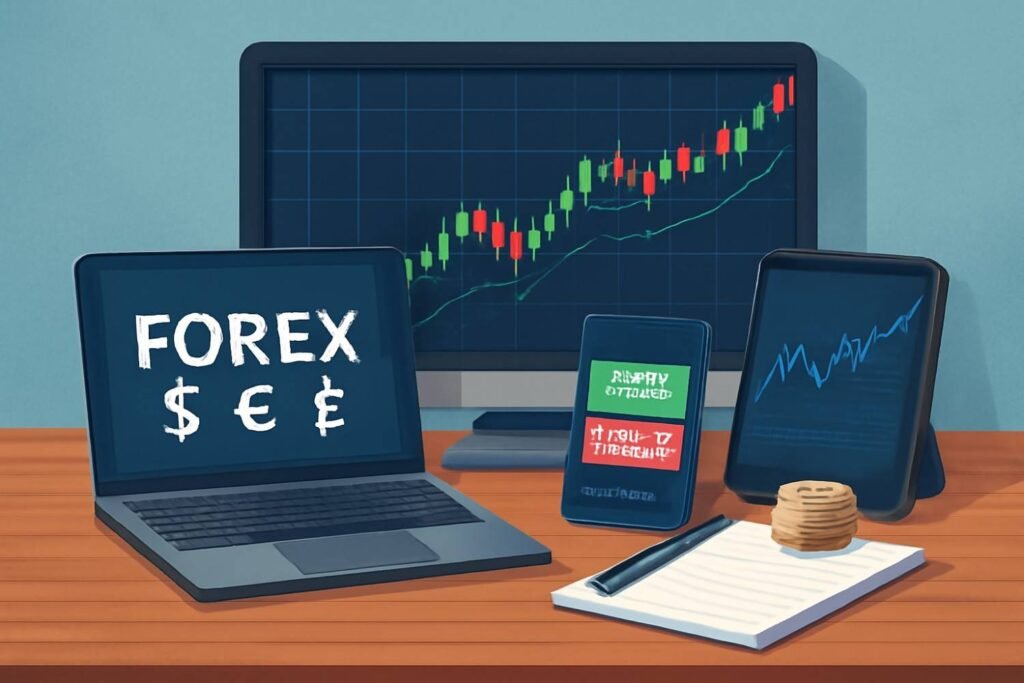
Entering the world of forex trading can seem overwhelming at first, but having the right tools can make the learning process smoother and more enjoyable. As a beginner, it’s essential to equip yourself with the proper forex trading toolkit that will help you make informed decisions, manage risk, and execute trades efficiently.
In this guide, we’ll walk you through the essential components of a complete forex trading toolkit and how to set it up step-by-step, ensuring that you’re well-prepared to start your trading journey.
1. Choosing a Forex Broker
Before you can start trading, you’ll need to select a reputable forex broker. Your broker acts as the intermediary between you and the market, so it’s essential to choose one that meets your needs.
Key Considerations:
-
Regulation: Ensure the broker is regulated by a reputable financial authority (e.g., FCA, CFTC, or CySEC). This ensures your funds are protected and the broker operates transparently.
-
Leverage: As a beginner, it’s essential to start with low leverage to avoid taking on too much risk. Many brokers offer leverage between 30:1 and 50:1 for retail traders, but be mindful of using leverage responsibly.
-
Account Types: Choose a broker that offers account types suitable for beginners, including demo accounts where you can practice without risking real money.
-
Spreads and Fees: Look for competitive spreads (the difference between the buy and sell price) and low fees. Narrow spreads are especially important for forex trading as they can impact your profitability.
-
Platform: Choose a broker that offers a trading platform with a user-friendly interface. MetaTrader 4 (MT4) and MetaTrader 5 (MT5) are widely recommended for beginners.
Recommended Brokers for Beginners:
-
IG Group
-
OANDA
-
Forex.com
-
eToro
-
Plus500
2. Setting Up a Trading Platform
Once you’ve selected your broker, the next step is to set up your trading platform. Most brokers offer trading platforms like MetaTrader 4 (MT4) or MetaTrader 5 (MT5, which are popular choices for beginners due to their user-friendly interfaces and comprehensive tools.
Key Features to Set Up on Your Platform:
-
Charts: Set up your charting system to monitor currency price movements. Choose a timeframe that aligns with your trading style (e.g., 1-minute, 15-minute, or 1-hour charts).
-
Indicators: Begin with essential indicators such as:
-
Moving Averages: Helps to identify trends and smooth out price action.
-
Relative Strength Index (RSI): Shows whether a currency pair is overbought or oversold.
-
MACD (Moving Average Convergence Divergence): Assists in identifying trend shifts and momentum.
-
-
Order Types: Learn how to place market orders, limit orders, and stop-loss orders on the platform. This will help you manage trades effectively.
-
Risk Management: Use the platform’s risk management tools, such as setting stop-loss and take-profit orders to protect your positions.
Example Setup:
-
MT4 or MT5 (download and install the platform provided by your broker).
-
Configure Timeframe: Select a timeframe for your charts (e.g., 1-minute for day trading or 1-hour for swing trading).
-
Add indicators like SMA (Simple Moving Average) and RSI (Relative Strength Index) to your charts for trend and overbought/oversold conditions.
3. Essential Forex Tools and Resources
3.1 Economic Calendar
An economic calendar provides important events and reports that can affect forex prices. This includes economic data releases such as GDP, unemployment, inflation, and interest rate decisions.
-
Why it’s important: These events can cause volatility in the forex market, and being aware of them helps you avoid trading during major announcements or use them to anticipate potential market moves.
Recommended Economic Calendars:
-
Forex Factory: Offers real-time updates on news events.
-
Investing.com: Provides a comprehensive economic calendar for global data releases.
3.2 News Feed and Analysis
Having access to real-time market news and expert analysis is essential for understanding market sentiment and making informed decisions.
-
Why it’s important: Forex markets are heavily influenced by geopolitical events, financial news, and market sentiment. Staying up-to-date on these factors can help you anticipate currency movements.
Recommended News and Analysis Platforms:
-
Bloomberg: Provides in-depth analysis and live market updates.
-
Reuters: Offers comprehensive global news and financial reporting.
-
Trading Economics: Provides up-to-date data on economic events and forecasts.
3.3 Forex Trading Calculators
Risk management is a crucial aspect of forex trading, and using trading calculators can help you determine position sizes, risk-to-reward ratios, and margin requirements.
-
Why it’s important: Using these calculators ensures that you are taking on an appropriate level of risk based on your trading strategy and account size.
Recommended Forex Calculators:
-
Position Size Calculator: Helps calculate how much to risk on each trade based on your account size and risk tolerance.
-
Pip Value Calculator: Helps determine the monetary value of each pip movement for different currency pairs.
4. Risk Management Tools
4.1 Stop-Loss Orders
A stop-loss order is essential for protecting yourself from significant losses. It automatically closes your trade if the price moves against you by a specific amount.
-
Why it’s important: Stop-losses help you limit losses and avoid emotional decision-making. It’s critical to set them at reasonable levels based on market conditions.
4.2 Position Sizing
Position sizing refers to the amount of capital you allocate to each trade. Proper position sizing helps you manage risk by ensuring that no single trade can wipe out a large portion of your trading capital.
-
Why it’s important: Knowing how much capital to risk on each trade is crucial for long-term success. As a beginner, it’s advisable to risk no more than 1-2% of your trading capital per trade.
4.3 Risk-to-Reward Ratio
The risk-to-reward ratio helps you assess the potential reward of a trade relative to the risk. A common strategy is to aim for a 2:1 or 3:1 ratio, meaning that for every dollar you risk, you aim to make two or three.
-
Why it’s important: This ratio helps you determine whether a trade is worth the risk and ensures that your potential profits outweigh your potential losses.
5. Trading Strategy and Plan
5.1 Developing a Trading Plan
A well-thought-out trading plan is crucial for success in forex trading. It defines your trading goals, strategies, risk management rules, and evaluation criteria.
Key components of a trading plan:
-
Trading Style: Decide whether you will be a day trader, swing trader, or position trader.
-
Entry and Exit Rules: Define your criteria for entering and exiting trades based on technical or fundamental analysis.
-
Risk Management: Set rules for how much capital to risk per trade, position size, and stop-loss/take-profit levels.
-
Review Process: Regularly review and evaluate your trades to improve your strategies.
5.2 Testing Your Strategy
Before applying your strategy to live markets, it’s essential to test it on demo accounts or through backtesting.
-
Why it’s important: Backtesting helps you evaluate the effectiveness of your strategy using historical data, while demo trading allows you to practice in real-time without risking real money.
6. Educational Resources for Continued Learning
6.1 Books and Online Courses
Educating yourself continuously is essential in forex trading. Look for reputable resources to improve your trading knowledge.
-
Recommended Books:
-
“Currency Trading for Dummies” by Brian Dolan
-
“The Little Book of Currency Trading” by Kathy Lien
-
-
Online Courses: Many platforms, like Babypips or Coursera, offer free or paid courses on forex trading strategies, technical analysis, and risk management.
6.2 Webinars and Forums
Engage with the trading community by attending webinars and participating in forums like Trade2Win and Forex Factory. These platforms offer insights, trading strategies, and networking opportunities with experienced traders.
Conclusion
Setting up a complete forex trading toolkit as a beginner involves selecting the right broker, configuring your trading platform, utilizing essential forex tools, incorporating risk management strategies, and continually educating yourself. By following these steps, you’ll be well-equipped to enter the forex market with confidence and a structured approach to trading.
Remember, forex trading is a journey that requires continuous learning and discipline. Start with the basics, and as you gain more experience, gradually expand your toolkit with more advanced tools and strategies.